The Foundation
Legal, ID checks, and the vocabulary you need before you touch a bottle.
Checking ID
+Checking ID isn't a formality — it's the one part of this job where a mistake can end your ability to work behind a bar at all. Here's the real breakdown.
How to Check It
- Require a valid, unexpired, government-issued photo ID — driver's license, state ID, passport, or military ID. Nothing else counts.
- Compare the photo to the person in front of you, not just a glance — actually look up from the ID to their face.
- Do the math on the birthdate. Don't estimate — count it out. This is where most missed unders slip through.
- Check the expiration date. In most states, an expired ID is not valid ID for alcohol service, full stop.
- Check for tampering: raised text that feels off, mismatched fonts, edges that look re-laminated, or a photo that looks slightly separated from the card.
- Know your state's layout. Many states print IDs for guests under 21 vertically and 21-and-over horizontally — if the format doesn't match the birthdate, that's a red flag.
- If your bar has a scanner or black light, use it every time — consistency protects you more than instinct.
The Fast Way To Do The Math
Take the birth year on the ID and add 21. Compare that number to the current year — this turns a subtraction into a quick comparison.
- Smaller than this year → already 21+. Serve.
- Same as this year → check if the birthday has happened yet. Already passed → 21, good. Hasn't happened yet → still 20, no sale.
- Bigger than this year → under 21, no sale. Don't even need to check the month.
Example (today's year: 2026) — DOB 2004: 2004+21=2025, before this year, serve. DOB 2005: 2005+21=2026, same year, check the actual birthday. DOB 2006: 2006+21=2027, after this year, no sale.
When to Ask
- The standard rule: "if they look under 30 (or your venue's cutoff), card them." Never guess based on confidence, clothing, or how they order.
- Ask before the first drink is made, not after it's already in front of them.
- When in doubt, always ask — a guest who's actually 35 being asked for ID is a non-event. A minor who wasn't asked is a real problem.
What To Do If It Looks Fake
- Stay calm and professional — no accusations, no scene. De-escalation is the job.
- You can ask a follow-up question the ID should answer instantly — birthdate, zip code, or a quick "what's your sign" style question people with real ID answer without hesitation.
- Simply decline the sale. You are never obligated to explain your reasoning in detail or debate it.
- Whether you can legally keep a suspected fake ID varies by state and by your specific employer's policy — some allow it, some don't. Know your venue's rule before you're in the moment, not during it.
- If a guest becomes hostile, disengage and get a manager or security involved. Never let it become a physical confrontation.
No ID, No Sale
If someone doesn't have ID on them, the answer is no — regardless of how old they appear, how they're dressed, or who they're with. There are no exceptions that protect you legally.
Penalties For Not Checking
- Fines to both the establishment and the individual server are common in most states.
- License consequences for the bar — suspension or, for repeat violations, revocation of the liquor license entirely.
- Criminal charges for the server personally are possible in many states, typically as a misdemeanor.
- Civil liability ("dram shop" laws): in many states, if a minor or a visibly intoxicated guest you served goes on to cause harm — a car accident, an injury — the establishment and sometimes the server can be held financially responsible for that harm.
- Job loss. Nearly every employer treats a failure to check ID as an immediate termination issue, regardless of intent.
Signs of Intoxication
+Reading intoxication accurately is a real skill — miss it, and you're either over-serving someone or wrongly cutting off a guest who's just tired, medicated, or dealing with something medical. Look at the whole picture, not one single sign.
Speech
- Slurring words, especially ones that weren't slurred earlier in their visit.
- Losing their train of thought mid-sentence, or repeating the same story.
- Volume creeping up — talking louder than the room requires.
Coordination
- Stumbling, swaying while seated, or missing the bar when reaching for their drink.
- Fumbling with money, cards, or their phone — struggling with tasks that were easy an hour ago.
- Spilling drinks, especially if it's out of character for that guest.
Behavior
- A noticeable mood shift — someone who was relaxed becomes aggressive, weepy, or overly affectionate.
- Glassy, unfocused, or heavy-lidded eyes.
- Becoming argumentative about the order, the bill, or things unrelated to the bar entirely.
Don't Confuse This With a Medical Emergency
Slurred speech, confusion, and stumbling are also signs of a stroke, seizure, diabetic emergency, or drug interaction — not just alcohol. If someone's symptoms seem sudden, severe, one-sided (like drooping on one side of the face), or don't match how much they've actually had to drink, treat it as a possible medical emergency and get help immediately rather than assuming it's simply intoxication.
Alcohol Combined With Other Drugs
+You're never expected to diagnose what a guest has taken — that's not the job, and guessing wrong helps no one. What matters is knowing that alcohol doesn't act alone in the body, and that a guest on certain common medications or drugs can become dangerously impaired on far less alcohol than usual, or look far more "sober" than they actually are.
Depressants Stack — They Don't Just Add Up
Alcohol is a central nervous system depressant. So are opioid painkillers, and so are anti-anxiety or sleep medications (the benzodiazepine family — Xanax, Valium, Ativan, and similar). Combining them doesn't just add their effects together — it compounds them, which is why someone on one of these medications can become severely impaired, or in serious cases stop breathing properly, on an amount of alcohol that would barely affect someone else.
Stimulants Can Hide Intoxication From the Guest Themselves
Cocaine, prescription stimulants (like ADHD medication), and even ordinary caffeine can mask the feeling of being drunk without actually reducing the alcohol's effect on the body or on driving ability. This is exactly why a caffeinated mixed drink — a Vodka Red Bull, a Jager Bomb — deserves the same attention as any other drink: a guest who "doesn't feel that drunk" while stimulated can still be well over a safe limit, and may keep ordering longer than someone without the stimulant would.
Marijuana ("Crossfading")
Combining alcohol and marijuana is common enough to have its own slang term, and the combined effect is genuinely unpredictable person to person — nausea, dizziness, and a sudden spike in impairment can show up with little warning, even in someone who handles either substance fine on its own.
What This Actually Means Behind the Bar
- You don't need to identify the substance — you need to notice when someone's impairment doesn't match how much they've visibly had to drink at your bar. That mismatch is the signal, not a specific diagnosis.
- Treat an unexplained, severe, or fast-arriving level of impairment as a higher-risk situation than ordinary over-service — cut off sooner, and get a manager involved sooner, rather than assuming "they can't be that drunk on two drinks."
- The same "Don't Confuse This With a Medical Emergency" rule above applies here too: severe or rapidly worsening symptoms are a reason to get help immediately, not a reason to debate what caused them first.
Illegal Drug Use or Dealing on the Premises
+This isn't asking you to become security or a detective — it's asking you to notice and report, not investigate or confront. Handling it wrong (confronting someone yourself) puts you at real personal risk for no benefit; handling it right (telling a manager immediately) is fast, low-risk, and exactly what the job requires.
What This Can Look Like
- A guest or group making repeated, brief trips to a restroom together — not universally meaningful on its own, but worth a manager's awareness if paired with other signs.
- Quick hand-to-hand exchanges of small items or folded cash between people who don't otherwise seem to know each other, especially if it repeats with different people over a short window.
- A guest who seems to be table-hopping or cycling through short interactions rather than settling in like a normal guest.
- Visible drug paraphernalia or use in a restroom, booth, or corner of the venue.
What To Actually Do
- Notify a manager — don't confront the guest yourself. You're not trained or equipped to handle a potentially volatile situation alone, and it isn't your job to be.
- Describe what you actually observed, factually — where, who, what you saw — rather than making an accusation. Let the manager decide what happens next.
- If you believe a coworker is using or dealing, the same rule applies: report it to a manager rather than confronting a colleague directly. This protects you, and it's the only version of this that reliably gets handled rather than escalating personally.
- If the situation feels physically unsafe in the moment, prioritize your own safety and the safety of guests around you over gathering more information — get away from it and get help.
The Cut-Off Script
+Most new bartenders freeze here — not because they don't know it's necessary, but because they don't have the actual words ready. Have a script memorized so it comes out calm and automatic, not hesitant.
The First Cut-Off (Calm, Simple)
"I'm sorry, but I've been instructed by management to stop alcohol service for the evening. Can I get you some water, a coffee, or call you a cab?"
This works because it puts the decision on "policy," not on a personal judgment call about the guest — much harder to argue with than "I think you've had enough."
If They Push Back
"I hear you, and I'm not trying to ruin your night — I just can't serve you any more alcohol. I'm happy to get you food or a water while you hang out."
Stay warm, not defensive. Repeating the same calm line is more effective than escalating your tone to match theirs.
If They Get Hostile
- Don't argue the point further yourself — disengage and bring in a manager or security.
- "Let me grab my manager so we can sort this out." This isn't passing the buck — it's exactly what that escalation path is for.
- Never physically block, grab, or corner a guest. Your job is to stop service and stay safe, not to enforce compliance physically.
Helping Them Get Home Safely
- Offer water and food regardless of whether they accept the cut-off gracefully — it's good practice and can genuinely help.
- Offer to call a cab or rideshare. Many venues will do this proactively rather than let a visibly intoxicated guest attempt to drive.
- If you believe someone intends to drive while intoxicated, tell a manager immediately — some venues have policies for these situations, including contacting authorities if necessary.
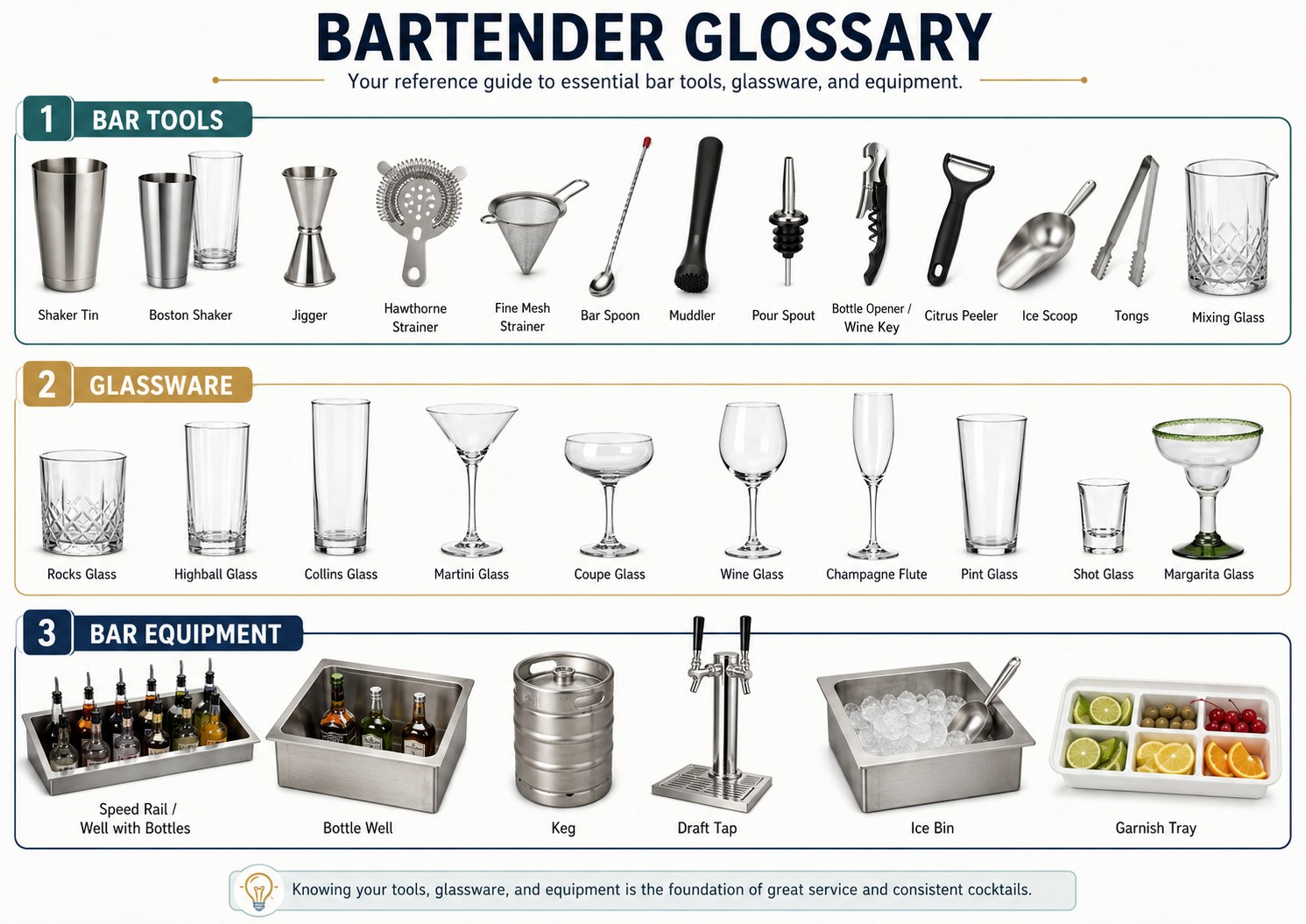
Bartender's Glossary
+- Standard shot (this app): 2 oz = a 4-count pour. That's the baseline every liquor amount below is built from.
- Count system: free-pouring by counting instead of using a jigger. Each count = 0.5 oz — so 2 counts = 1 oz, 3 counts = 1.5 oz, 4 counts = 2 oz.
- Build: pour ingredients directly into the serving glass, no shaking or stirring needed (a Rum and Coke is built).
- Shake: used for drinks with juice, dairy, or egg white — you want it cold and slightly diluted with texture (a Whiskey Sour is shaken).
- Stir: used for spirit-forward drinks with no juice — you want it cold without over-diluting or clouding it (an Old Fashioned is stirred).
- Jigger: the small hourglass-shaped tool used to measure exact pours — guessing is how a bar loses money.
- Muddle: pressing fruit or herbs to release oils and juice, like mint in a Mojito.
- Up (served up): the drink is chilled by shaking or stirring it with ice, then strained into a stemmed glass with no ice at all — "up" tells you the glass will be empty of ice, not that anything is missing from the recipe (a Manhattan and a Martini are both served up).
- Strained: only the chilled liquid goes into the guest's glass — the ice stays behind in the shaker or mixing glass. This is different from "shaken over ice," where the ice itself gets poured into the glass along with the drink.
- Layered (floated): pouring one ingredient slowly, often over the back of a bar spoon, so it settles in its own visible band instead of mixing — used on shot drinks like a B-52 or Buttery Nipple, where the look depends on the layers staying separate.
- Dropped (bomb shot): a full shot glass is dropped, glass and all, into a larger drink (beer, an energy drink) and taken together on the spot — an Irish Car Bomb or Jager Bomb, not something you stir together first.
- Rocks glass: short, wide glass for spirits served over ice (Old Fashioned).
- Highball glass: tall glass for spirit-plus-mixer drinks with more volume (Rum and Coke, Gin and Tonic).
- Coupe: the shallow stemmed glass for drinks served "up," with no ice (Cosmopolitan, Daiquiri).
- Well liquor: the house-brand spirits poured when a guest doesn't request a specific brand.
Glassware Reference
+
Ice Guide
+- Cubed ice: the standard, all-purpose ice for most built and shaken drinks — melts at a moderate, predictable rate.
- Crushed ice: used for tropical and julep-style drinks (Mojito, Mint Julep, Mai Tai) — melts faster, adding more dilution and a colder, slushier feel.
- Large-format ice (one big cube or sphere): used in spirit-forward drinks served on the rocks, like an Old Fashioned — minimizes surface area so the drink stays cold without watering down quickly.
- Why it matters: the wrong ice size changes a drink's actual character, not just its look — crushed ice in an Old Fashioned would dilute it far faster than the recipe intends.